Why Modular Construction Uses Lightweight Wall Panels?
The global construction industry is rapidly embracing modular construction as developers seek faster project delivery, improved building efficiency, and more sustainable construction methods. One of the key materials driving this transformation is the Lightweight Wall Panel.
Many architects, contractors, developers, and building material manufacturers ask: Why Does Modular Construction Use Lightweight Wall Panels?
This guide explores the advantages of lightweight wall panel systems, explains how they support modular building technology, and highlights why they have become a preferred solution for residential, commercial, and industrial projects.
What Are Lightweight Wall Panels?
Lightweight Wall Panels are prefabricated wall components manufactured from cement, fly ash, EPS (expanded polystyrene), lightweight aggregates, reinforced materials, and other engineered building materials.
These panels are widely used as:
Interior partition walls
Exterior wall systems
Prefabricated building panels
Modular house wall panels
Industrial building walls
Commercial partition systems
Compared with traditional brick masonry, lightweight partition panels provide faster installation while reducing structural loads.
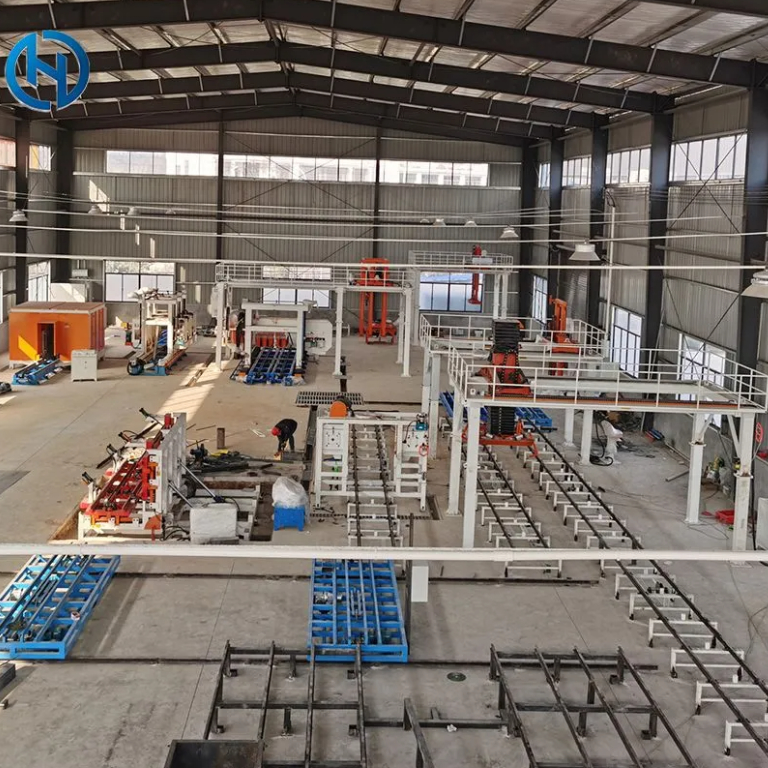
200 Cubic Meter Wall Panel Production Line (High-End Configuration)
Why Are Lightweight Wall Panels Ideal for Modular Construction?
Modern modular building systems rely on factory-produced components that can be transported and assembled efficiently.
Lightweight wall panels offer several important advantages.
Reduced Structural Weight
Lower wall weight reduces the overall load on foundations and structural frames.
This allows engineers to optimize structural design while improving transportation and installation efficiency.
Faster Installation
Prefabricated panels are manufactured in advance and delivered directly to the construction site.
This significantly shortens construction schedules compared with traditional masonry work.
Higher Construction Efficiency
Factory-controlled production improves dimensional consistency and minimizes on-site labor requirements.
The result is more efficient project management and faster building completion.
Excellent Thermal Insulation
Many lightweight sandwich wall panels provide effective thermal insulation, helping improve indoor comfort and reduce building energy consumption.
Sound Insulation Performance
Modern panel systems also deliver excellent acoustic performance for apartments, offices, schools, hotels, and hospitals.
Fire Resistance
Properly designed cement lightweight wall panels provide reliable fire resistance suitable for many commercial and residential applications.
How Are Lightweight Wall Panels Manufactured?
High-quality panels are produced using an advanced Lightweight Wall Panel Production Line.
The production process generally includes:
Raw material batching
Automatic mixing
Mold filling
Panel forming
Curing
Demolding
Quality inspection
Packaging and storage
Automated production ensures consistent quality, accurate dimensions, and stable manufacturing efficiency.
What Materials Are Commonly Used?
Modern lightweight wall panels are manufactured using carefully selected materials such as:
Cement
Fly ash
EPS particles
Calcium silicate
Reinforcement mesh
Lightweight aggregates
Water-reducing additives
Different material combinations provide varying levels of strength, insulation, durability, and fire performance.
Where Are Lightweight Wall Panels Used?
The versatility of prefabricated wall panel systems makes them suitable for many industries.
Residential Buildings
Apartments, villas, townhouses, and modular homes.
Commercial Buildings
Office buildings, shopping centers, and business complexes.
Hotels
Guest rooms, corridors, conference facilities, and service areas.
Hospitals
Patient wards, medical offices, laboratories, and healthcare facilities.
Educational Buildings
Schools, universities, classrooms, and training centers.
Industrial Buildings
Factories, warehouses, logistics centers, and production workshops.
Why Is Modular Construction Growing Worldwide?
The popularity of modular construction continues to increase because it offers:
Faster project delivery
Reduced construction waste
Better quality control
Improved worker safety
Higher production efficiency
Lower environmental impact
Flexible building design
Sustainable construction practices
Lightweight wall panel technology plays a major role in supporting these industry trends.
What Should Buyers Consider?
When selecting lightweight wall panels or a Lightweight Wall Panel Production Line, buyers should evaluate:
Production Capacity
Select equipment that matches projected manufacturing volume.
Automation Level
Modern production lines improve consistency and reduce labor requirements.
Panel Specifications
Different projects require different panel thicknesses, lengths, and structural properties.
Raw Material Compatibility
Flexible production systems can process multiple lightweight material formulations.
Equipment Reliability
Stable operation helps improve production efficiency and reduce downtime.
Technical Support
Reliable engineering assistance, commissioning, operator training, and after-sales service contribute to long-term manufacturing success.
Why Choose Hengde Building Materials?
Hengde Building Materials specializes in manufacturing advanced Lightweight Wall Panel Production Lines, lightweight wall panel machinery, prefabricated building equipment, and complete production solutions for modern building material manufacturers.
Key advantages include:
Advanced automated production technology
Efficient continuous manufacturing
Flexible panel specification capability
Stable production performance
Energy-efficient equipment design
Customized production line solutions
OEM and engineering support
Professional installation and commissioning
Comprehensive technical training
Global project experience
Hengde Building Materials helps customers establish efficient, reliable, and scalable production facilities for high-quality lightweight wall panel manufacturing.


Comments
Post a Comment